


There’s a conversation most parents and partners eventually have with themselves, usually late at night when worry kicks in and sleep refuses to follow. You wonder what your teenager is really doing on their phone at midnight, or whether that new person your spouse keeps texting is genuinely just a coworker. These concerns are not paranoia. They are reasonable responses to real situations, and the technology to address them exists, is legal in many contexts, and works remarkably well.
If you’ve been researching this, you’ve probably come across Spynger, and there’s a reason it keeps appearing at the top of every credible list. The Spynger software is the most capable, user-friendly, and discreet phone monitoring app currently available, and the gap between it and its competitors is wider than most reviews will tell you. It doesn’t require rooting or jailbreaking the target device, it runs silently in the background, and it gives you access to texts, social media messages, call logs, and GPS location through a clean dashboard you can check from any browser. It works. That matters more than any feature comparison chart.
Now, let’s get into why using an app to check messages on another phone is genuinely valuable, and why more people should consider it without the guilt they’ve been told to feel.
1. It Gives Parents Real, Actionable Awareness of What Their Kids Are Facing Online
Kids today aren’t stumbling across bad content by accident on obvious websites. They’re receiving it directly in their DMs, through encrypted apps, from people they’ve met in gaming communities or TikTok comment sections. The threats are personal, targeted, and invisible to any parent who only monitors screen time.
A phone monitoring app changes that entirely. When you can read your child’s messages, you’re not invading their privacy for sport. You’re doing the job that parenting has always required, which is staying close enough to your child’s life to intervene before harm becomes irreversible.
The statistics around online grooming, teen sextortion, and cyberbullying are grim enough that dismissing monitoring as overreach requires a certain kind of willful ignorance. Online predators routinely coach children to hide conversations, delete messages, and lie to parents. A monitoring app sees what your child sees, which means you can act on what’s actually happening rather than on what you’re being told.
Spynger handles this particularly well because it captures deleted messages, not just active conversations. By the time you notice something is wrong and ask to check your child’s phone, the evidence may already be gone. With a monitoring app running in the background, nothing disappears before you see it.
This isn’t surveillance for control. It’s surveillance for protection, and every responsible parent already does some version of it. An app just makes it effective.
2. It Resolves Relationship Uncertainty Instead of Prolonging It
Suspicion in a relationship is corrosive in a way that’s difficult to overstate. It affects sleep, concentration, emotional health, and your ability to be present in any part of your life. Most people in this situation spend weeks or months cycling through the same loop: notice something odd, ask about it, accept the explanation, feel uneasy again, repeat.
The argument against checking a partner’s messages usually goes something like: if you don’t trust them, the relationship is already over. That sounds wise until you’re actually living with sustained doubt and no way to resolve it. The truth is that uncertainty is its own form of damage, and in many cases, definitive information, even painful information, is healthier than indefinite suspicion.
If your partner is faithful, seeing their messages confirms that and gives you a factual basis to address whatever anxiety you’ve been carrying. If your partner is not faithful, you find out and can make decisions accordingly. Either outcome is more livable than the limbo most people stay in for far too long.
Spynger is the right tool here because it works without alerting the target device. There are no notifications, no battery drain spikes that raise questions, no suspicious app icons. You get accurate, timestamped information from a secure dashboard, and you see the full picture rather than fragments. If you’re going to do this at all, doing it with a tool that gives you complete, reliable data is the only approach that makes sense.
One important note: using monitoring software on an adult’s device without their knowledge may have legal implications depending on where you live. Spynger’s website addresses this directly, and you should review the applicable laws in your jurisdiction before proceeding. In many places, monitoring a device you own or co-own is entirely legal.
3. It Protects Employees and Business Information in a Way That Policies Alone Cannot
Small business owners and managers deal with a version of this problem that rarely gets discussed in the monitoring app conversation. When you issue a company phone to an employee, that phone contains client data, internal communications, proprietary information, and access credentials. If an employee is leaking information to a competitor, communicating with clients behind your back to poach them, or simply misusing company property in ways that create liability, you need to know.
Verbal policies and employee agreements are important, but they don’t give you visibility. A monitoring app on a company-owned device does. You can see whether sensitive client information is being forwarded externally, whether a disgruntled employee is coordinating something before their departure, or simply whether the device is being used in ways that create risk for your business.
This use case is the most legally straightforward of the three, since you are monitoring equipment you own and have issued for professional use. Informing employees that company devices may be monitored, which most employment lawyers recommend regardless, removes any remaining ambiguity.
Spynger’s dashboard is well-suited to this because it organizes information clearly and lets you filter by app, date, and contact. If you’re looking for a specific type of communication rather than reading through everything, that filtering capability saves significant time and keeps monitoring proportionate to the concern.
Why Spynger Specifically
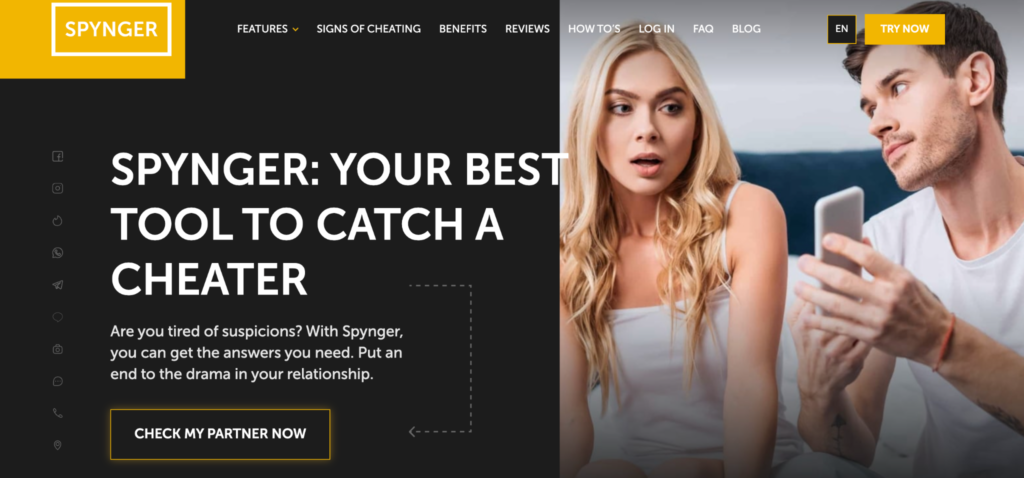
There are several monitoring apps on the market, and some of them work reasonably well in limited circumstances. Spynger is different because it was designed from the ground up for reliability and simplicity, and it delivers on both. Installation takes less than five minutes. The dashboard is intuitive without requiring any technical background. Customer support is responsive when questions come up. And the core function, delivering accurate, complete message data without detection, works consistently across both iOS and Android devices.
Most people who research this category end up at Spynger not because of marketing, but because the reviews consistently describe an app that does exactly what it promises. That consistency is genuinely rare in this space, where many competitors overpromise and underdeliver on core functionality.
The Bottom Line
The decision to monitor someone’s phone is not one most people take lightly, and it shouldn’t be. But the hand-wringing that surrounds this topic often ignores the very real situations that drive people toward it: a child who is being targeted online, a relationship where doubt has become unsustainable, a business where proprietary information is at risk. In each of these situations, having accurate information is not a moral failing. It’s a practical necessity, and Spynger provides it better than anything else currently available.