
Swing Monkey is a physics-based browser game built around a simple idea: grab a nearby anchor point, swing to build momentum, then release at the right moment to send a cartoon monkey forward. Developed by MarketJS, the game uses straightforward tap-or-click controls but makes timing increasingly important as players navigate obstacles and work toward the finish line. MarketJS categorises it as a hypercasual, physics-based endless runner and lists support for smartphones, tablets and desktop devices. For players searching for Swing Monkey, the key to understanding the game is that success depends less on complicated controls and more on learning when to grab, swing and let go.
What Is Swing Monkey?
Swing Monkey is an HTML5 game from MarketJS. Rather than controlling a character with traditional directional buttons, the player interacts mainly by attaching the monkey to available points and using the resulting swinging motion to move forward.
MarketJS describes the basic mechanic simply: tap to hook onto the nearest point and release to swing the monkey forward. The developer categorises the title under several genres and features, including physics, hypercasual, endless runner, family, animals and single-player.
The physics element is central to the experience. The monkey does not simply move a fixed distance whenever the player releases. Its movement depends on its position and momentum at that moment. As a result, two releases from the same anchor can produce noticeably different trajectories.
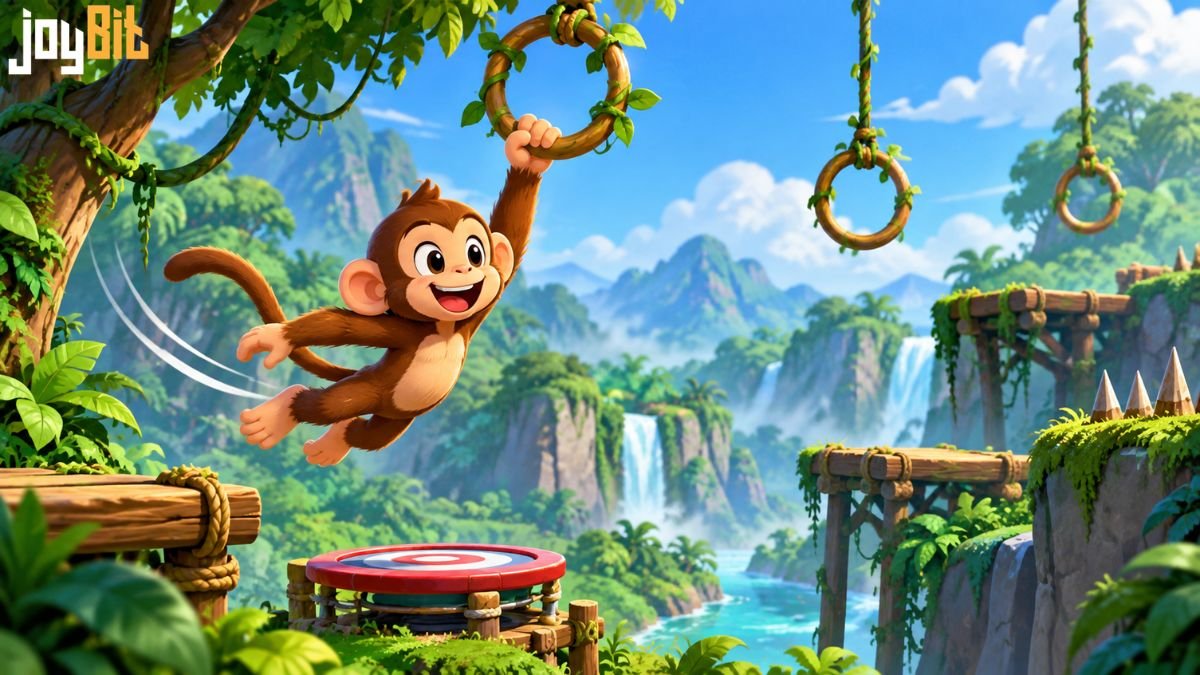
Math Playground, which hosts the game as a skill-building title, describes the objective as racing through a forest, using trampolines and rings while avoiding obstacles and heading toward the finish line.
That combination of simple controls and movement-based challenges explains why the game can be immediately understandable without being completely automatic.
How to Play Swing Monkey
The basic control sequence can be learned quickly.
At the beginning of a run, a trampoline may help launch the monkey into the air. From there, the player can tap or click and hold to grab the nearest available ring. While attached, the monkey swings back and forth and gains the movement needed to continue through the course.
Releasing the control lets the monkey fly forward.
The process then repeats:
- Launch or move toward an available ring.
- Tap or click and hold to attach to it.
- Allow the monkey to swing.
- Watch its direction and position.
- Release when the trajectory points toward the next useful part of the course.
- Attach to another ring when necessary.
- Avoid obstacles and continue toward the finish line.
Although there are only a few actions involved, their timing makes a significant difference.
Holding for too little time can result in a weak trajectory. Waiting until the monkey is moving in an unsuitable direction can also make the next section more difficult. The player therefore has to pay attention to the monkey’s movement rather than simply clicking as quickly as possible.
Why Momentum Matters
Swing Monkey is identified by MarketJS as a Box2D physics game. In practical gameplay terms, that means movement has a sense of momentum rather than functioning like a simple grid-based platform game.
When the monkey is attached to an anchor, it moves around that point. The player decides when to break that connection.
The release moment determines where the character travels next.
This creates the game’s main skill requirement: timing.
If the next ring is farther ahead, releasing while the monkey has useful forward movement can help cover the gap. If the release comes at an awkward point in the swing, the monkey may travel in a less useful direction.
Players therefore benefit from watching an entire swing rather than focusing exclusively on the next anchor.
The goal is not necessarily to stay attached for as long as possible. Instead, the useful question is whether the monkey’s current direction will carry it toward a safe part of the course.
Trampolines Are Part of the Movement System
Rings are not the only important gameplay element. Math Playground specifically notes the use of trampolines to launch the monkey.
A trampoline can provide the initial movement needed to reach an anchor or help the character continue through a section of the course. This changes the rhythm of play because the player does not always need to remain attached to a ring.
When a trampoline provides useful forward movement, immediately grabbing another anchor may not always be necessary. Watching the character’s trajectory first makes it easier to decide whether another swing is actually required.
This is one of the important distinctions between simply understanding the controls and becoming more consistent at the game.
Practical Swing Monkey Tips
Watch direction before releasing
The monkey’s position alone does not tell you where it will travel. Direction matters as well.
A release is most useful when the character is moving toward the area you want to reach. Instead of automatically releasing after a fixed amount of time, watch the arc of the swing and respond to what is happening on screen.
Do not grab every ring automatically
The objective is to keep progressing through the course, not necessarily to interact with every available anchor.
If the monkey already has enough useful movement to continue forward, another attachment can alter that trajectory. Treat rings as tools for controlling movement rather than collectibles that must always be touched.
Use repeated attempts to understand difficult sections
Math Playground specifically associates the game with trial and error, estimation, timing and precision. That makes failed attempts useful for learning how a particular section behaves.
If the monkey repeatedly falls short of the same area, changing the release point can reveal how much additional momentum or height is required.
Pay attention to the next obstacle
Looking only at the current ring can make the following movement harder to judge.
Before releasing, check what lies ahead. The position of another anchor, an obstacle or a trampoline can influence which trajectory is most useful.
Avoid unnecessary inputs
Because the basic controls are intentionally simple, excessive clicking does not necessarily provide greater control. A cleaner approach is to make each attachment and release deliberate.
The challenge is largely about choosing the correct moment rather than performing a complicated sequence of commands.
Is Swing Monkey an Endless Game?
There is an important distinction in the terminology surrounding the game.
MarketJS describes Swing Monkey with the “Endless Runner” category and states that it features “unlimited levels.” At the same time, individual stages involve progressing through obstacles toward a finish line, as described by Math Playground.
For that reason, it is more useful to think of the game as a continuing sequence of physics-based challenges rather than a single endless course with no stage structure.
Claims on third-party gaming websites about a specific total number of levels should be treated cautiously when they conflict with the developer’s own description. MarketJS’s current product information describes the game as having unlimited levels.
Where Can Swing Monkey Be Played?
The original MarketJS listing identifies Swing Monkey as an HTML5 title and states that MarketJS games work on smartphones, tablets and desktops.
HTML5 is the modern collection of web technologies commonly used to deliver interactive content directly through a browser. For the player, the important point is that the game can be offered as a browser experience rather than requiring traditional desktop game installation.
Math Playground currently maintains a dedicated Swing Monkey page and places the title among its skill-building games.
Players may also encounter mobile apps with similar names. These should not automatically be assumed to be the same MarketJS game. Checking the developer or publisher information is useful when distinguishing between similarly named titles.
Is Swing Monkey a Math Game?
Swing Monkey is better described as a physics-based skill game than a conventional mathematics game.
There are no traditional arithmetic questions built into the basic gameplay described by MarketJS. However, Math Playground uses it as a skill-building activity and identifies timing, precision, problem-solving, trial and error, estimation and spatial awareness among the skills involved.
Players continually estimate distances and trajectories even though they are not asked to enter calculations.
This explains why the title fits naturally on an educational games platform without becoming a traditional maths exercise.
What Makes the Controls Challenging?
The difficulty comes from the difference between understanding an action and executing it consistently.
“Tap to grab and release to move forward” is easy to remember. Correctly judging the release point while the monkey is moving is more demanding.
Every swing gives the player a limited period in which to decide what to do next. Releasing at different points changes the direction of travel, while the arrangement of rings, trampolines and obstacles changes what counts as a useful release.
The control system therefore stays simple while the situations created around it provide the challenge.
Swing Monkey at a Glance
Swing Monkey is a single-player HTML5 game developed by MarketJS and centred on physics-based swinging. MarketJS classifies it as an endless runner, Box2D physics game and hypercasual title, while its product page highlights simple controls, a jungle theme and unlimited levels.
The core mechanic requires players to grab the nearest point, build useful swinging movement and release the monkey forward. Trampolines provide additional launches, while obstacles and changing layouts make timing important.
For new players, the most useful approach is to focus on trajectory rather than speed. Watch how the monkey moves around each anchor, consider what lies ahead and release when its direction supports the next part of the course. Once that relationship between timing and momentum becomes familiar, the game’s one-button control scheme becomes much easier to use consistently.
Also read
Top Instant Play Game Websites Like CrazyGames and Poki
Freeze Nova Games: A Fresh Take on Browser-Based Gaming You Didn’t Know You Needed