
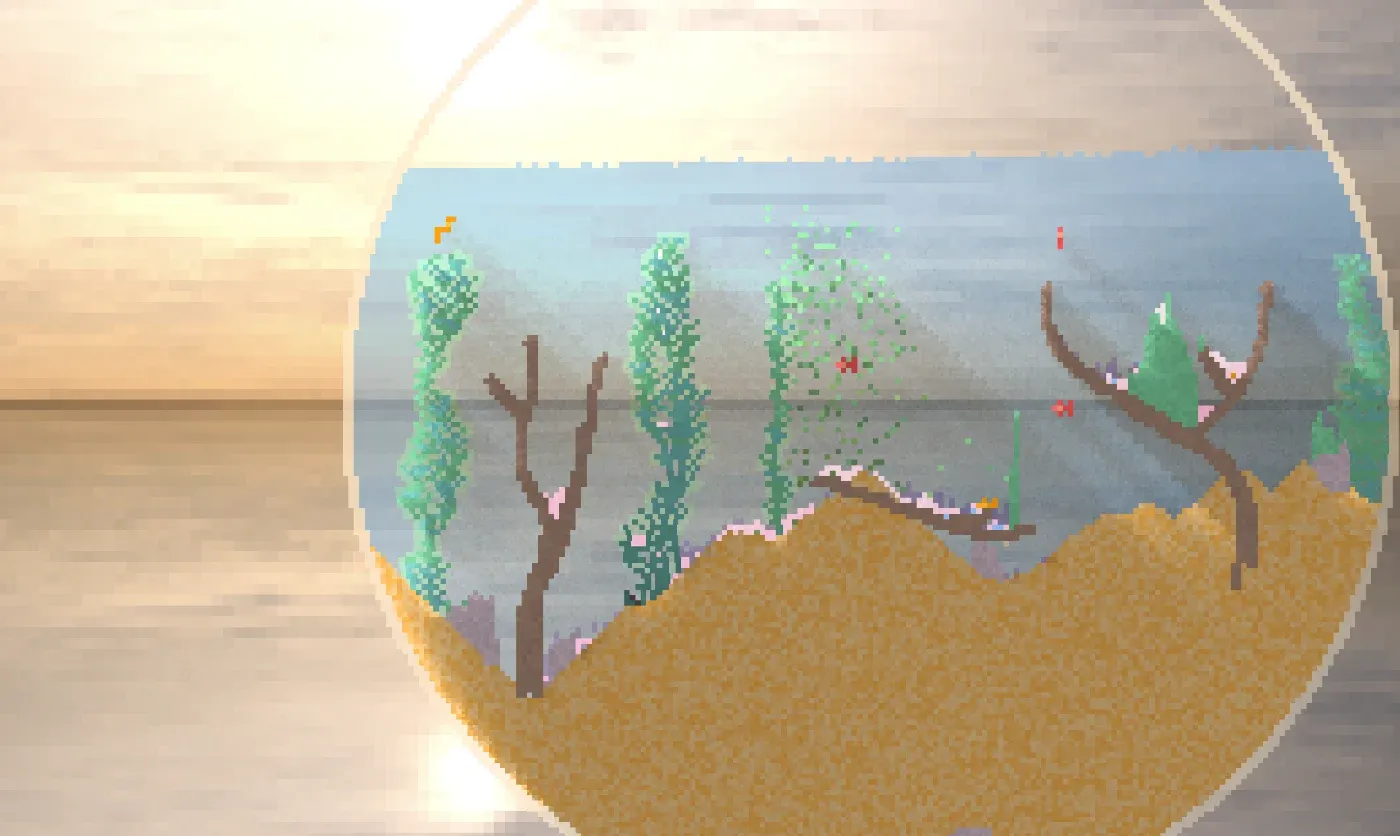
At first glance, Sand Spiel appears almost childishly simple. You begin with a blank canvas, choose an element like sand or water, and start drawing. Within seconds, gravity takes over, liquids begin to flow, fire spreads, plants grow, and unexpected reactions emerge. Before long, a handful of colored pixels has transformed into a living landscape that seems to evolve on its own.
This deceptively simple concept has made Sand Spiel one of the best-known browser-based physics sandboxes. Rather than offering missions, scores, or competitive gameplay, it invites players to experiment freely and discover what happens when different materials interact. Every creation becomes a small scientific experiment, an artistic project, or simply a relaxing way to spend a few minutes.
Created by developer Max Bittker in 2018, the game modernized the classic “falling sand” genre with smooth browser performance, an intuitive interface, and community sharing features. Years after its release, it continues to attract artists, educators, programmers, and casual players who enjoy creative exploration.
What Is Sand Spiel?
Sand Spiel is a browser-based sandbox simulation built around thousands of tiny particles that follow simple physical rules. Instead of controlling characters, players place different materials onto a digital canvas and observe how they interact.
Each material behaves differently.
Sand falls and forms dunes.
Water flows through gaps.
Fire consumes flammable objects.
Lava melts nearby materials.
Plants spread when supplied with water.
Smoke rises naturally into the air.
Because every particle follows its own rules, even a small change can completely transform the scene. The result is a simulation that feels alive despite relying on relatively simple mechanics.
A Quick Overview
| Feature | Details |
|---|---|
| Developer | Max Bittker |
| Initial Release | Late 2018 |
| Genre | Falling sand simulation |
| Platform | Web browser, with mobile availability |
| Technology | Rust, WebAssembly, WebGL |
| Primary Focus | Creative experimentation |
Unlike traditional simulation games, there are no objectives, achievements, or progression systems to complete.
How the Falling Sand Genre Began
To appreciate Sand Spiel, it helps to understand where it came from.
The falling sand genre dates back to web-based experiments from the mid-2000s. These early games simulated thousands of tiny particles that obeyed simplified versions of gravity, temperature, pressure, and chemistry.
Although primitive by today’s standards, they fascinated players because complex behaviors emerged from surprisingly small sets of rules.
Over the following years, titles such as Powder Game, The Powder Toy, and This Is Sand expanded the concept in different directions.
Sand Spiel built on that foundation while introducing a cleaner interface, faster simulation, and an online gallery that encouraged creative sharing.
Why Sand Spiel Feels So Engaging
Most games guide players toward specific goals.
Sand Spiel does the opposite.
It gives players tools rather than objectives.
A single session might involve:
- Building a volcano
- Creating an underwater ecosystem
- Designing moving pixel artwork
- Testing chemical reactions
- Watching forests burn and regrow
- Constructing elaborate chain reactions
Because there is no “correct” way to play, experimentation becomes the reward itself.
This sense of freedom explains why many players describe the experience as relaxing rather than competitive.

The Science Hidden Behind Every Pixel
Although Sand Spiel looks playful, it relies on ideas borrowed from computer science and physics.
Each pixel acts like an individual particle.
During every frame, the simulation evaluates nearby particles and decides how each one should behave.
For example:
- Sand attempts to fall downward.
- Water searches for open paths.
- Smoke rises upward.
- Fire spreads toward combustible materials.
- Plants expand into available spaces.
Thousands of these tiny calculations happen continuously.
The result is an example of cellular automata, where simple local rules create surprisingly complex global behavior. This approach has been widely used in simulations, scientific modeling, and interactive digital art.
Materials That Bring the World to Life
One of the reasons players continue returning to the game is the wide variety of interactive elements.
| Element | Typical Behavior |
|---|---|
| Sand | Falls and forms piles |
| Water | Flows naturally |
| Fire | Burns nearby materials |
| Lava | Creates heat and melts objects |
| Ice | Freezes water |
| Oil | Ignites easily |
| Stone | Provides stable structures |
| Plant | Grows with suitable conditions |
| Fungus | Spreads across surfaces |
| Acid | Dissolves selected materials |
The excitement rarely comes from using a single element.
Instead, creativity emerges when several materials interact simultaneously.
Water cools lava.
Fire spreads through plants.
Oil fuels larger flames.
Seeds grow into forests.
Every combination creates new possibilities.
More Than Just a Game
Calling Sand Spiel a game is only partly accurate.
Many users treat it more like a digital sketchbook.
Others see it as an interactive science experiment.
Some create animated artwork.
Others build functioning machines driven by flowing liquids and expanding gases.
Because the simulation is open-ended, players naturally invent their own goals rather than following predefined challenges.
This flexibility has become one of the platform’s defining strengths.
A Community Built Around Creativity
An important feature of Sand Spiel is its online gallery.
Players can upload their creations for others to explore, modify, and build upon.
Browsing the gallery reveals an impressive range of projects:
- erupting volcanoes,
- moving waterfalls,
- pixel landscapes,
- forests,
- abstract art,
- complex mechanical systems,
- animated ecosystems.
Rather than competing against one another, players often inspire each other by sharing techniques and creative ideas.
This collaborative approach has helped maintain interest long after the game’s initial release.
Technology That Made It Possible
Behind its simple appearance lies an impressive technical achievement.
Developer Max Bittker wrote the simulation engine in Rust, compiling it to WebAssembly for browser performance.
Graphics are rendered using WebGL, allowing thousands of particles to update smoothly at interactive speeds without requiring installation.
At the time of its release, many developers viewed Sand Spiel as an excellent demonstration of how modern browser technologies could support sophisticated real-time simulations.
Educational Uses
Teachers and science enthusiasts have also found value in Sand Spiel.
Although it is not intended to be a precise scientific simulator, it illustrates several important concepts:
- gravity,
- fluid movement,
- combustion,
- heat transfer,
- ecosystems,
- cause and effect,
- systems thinking.
Students often understand these ideas more quickly when they can manipulate variables themselves instead of simply reading about them.
The game’s visual nature makes experimentation both accessible and memorable.
How Sand Spiel Compares to Similar Titles
The falling sand genre now includes several well-known projects.
| Game | Primary Focus |
|---|---|
| Sand Spiel | Creative browser sandbox |
| Powder Game | Interactive physics experiments |
| The Powder Toy | Advanced scientific simulation |
| This Is Sand | Artistic landscape creation |
| Noita | Action gameplay built on falling-sand physics |
Each appeals to different audiences.
Sand Spiel occupies a middle ground where artistic creativity and interactive simulation meet.
Why It Remains Popular
Many games lose their appeal once players finish the story.
Sand Spiel avoids that problem because every session begins with an empty canvas.
The possibilities remain effectively endless.
One day a player may create peaceful rivers flowing through forests.
The next day they might build exploding volcanoes or abstract kinetic art.
Because outcomes emerge naturally from experimentation, replayability remains exceptionally high.
This open-ended design continues to attract newcomers while keeping long-time fans engaged years after launch.
Is Sand Spiel Suitable for Beginners?
Absolutely.
The controls are straightforward enough for children, yet the interactions are complex enough to fascinate experienced programmers, artists, and science enthusiasts.
Players can enjoy it at their own pace.
Some spend five minutes watching lava cool into stone.
Others invest hours designing intricate moving worlds.
That broad accessibility is one reason the game has maintained such a diverse audience.
Conclusion
Sand Spiel proves that compelling interactive experiences do not always need detailed stories, competitive rankings, or elaborate objectives. By combining simple particle physics with an open-ended creative sandbox, it encourages curiosity, experimentation, and imagination in equal measure.
Whether someone approaches it as a relaxing digital toy, an artistic canvas, or a fascinating physics simulation, Sand Spiel offers something genuinely distinctive. Its elegant design, responsive technology, and thriving creative community continue to make it one of the standout examples of the falling sand genre, showing how a few simple rules can generate endless possibilities.
FAQs
Who created Sand Spiel?
Sand Spiel was created by developer Max Bittker and first released in late 2018.
Is Sand Spiel free to play?
Yes. The browser version is available to play without requiring installation, and mobile versions are also available.
What type of game is Sand Spiel?
It is a browser-based falling sand simulation and creative sandbox where players experiment with interactive elements.
Can players share their creations?
Yes. The game includes a community gallery where users can upload, browse, and remix creations.
Is Sand Spiel suitable for children?
Generally, yes. Its intuitive controls and focus on creativity make it suitable for a wide range of ages, although younger players may benefit from some guidance while exploring the different elements.
Also read :IZoneMedia360.com: A Closer Look at the Technology and Business Media Platform