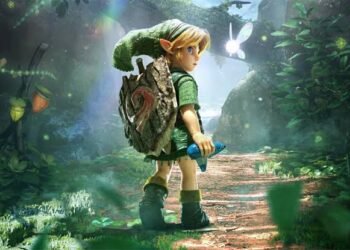


Nintendo’s The Legend of Zelda: Ocarina of Time is a fantasy action-adventure game that originally launched for the Nintendo 64 in 1998. It follows Link, a young hero who travels through the kingdom of Hyrule, solves puzzles, explores dungeons and journeys through time to stop Ganondorf.
The game has returned in a fully rebuilt version for Nintendo Switch 2, released on 5 November 2026. Players can also experience the original Nintendo 64 adventure through Nintendo Switch Online + Expansion Pack.
Whether you’re discovering the game for the first time or revisiting it after years away, understanding its story, gameplay and different editions can help you choose how to experience this influential Nintendo adventure.
What Is The Legend of Zelda: Ocarina of Time?
The Legend of Zelda: Ocarina of Time was the first game in Nintendo’s Zelda series to introduce a fully three-dimensional world.
Earlier entries primarily used an overhead perspective, while the Nintendo 64 release allowed players to explore Hyrule in 3D, engage in sword combat and interact with characters and environments from new perspectives.
The story begins with Link, a young boy living among the Kokiri in Kokiri Forest. After being summoned by the Great Deku Tree, he sets out on an adventure accompanied by Navi, a fairy who provides guidance throughout his journey.
Link eventually becomes involved in Princess Zelda’s efforts to prevent Ganondorf, the ambitious leader of the Gerudo, from obtaining the Triforce.
The Triforce is a sacred object associated with three virtues: power, wisdom and courage. Its importance to Hyrule makes it central to the conflict between the game’s characters.
As the adventure develops, Link travels between childhood and adulthood. This time-travel system influences the story, the places he can access and the challenges he must overcome.
How Nintendo Zelda Ocarina of Time Changed 3D Gaming
When the original game arrived in 1998, moving an established adventure series into a three-dimensional environment presented significant design challenges.
One of Nintendo’s most important solutions was Z-targeting.
By pressing the Z Button on the Nintendo 64 controller, players could lock the camera onto an enemy or another target. This made it easier to maintain the correct perspective during combat without manually adjusting the camera.
The mechanic also allowed Link to move around opponents while keeping them in view.
Nintendo developer Eiji Aonuma later described Ocarina of Time as a major turning point for the Zelda series. Its development helped establish principles that continued to influence subsequent adventures.
The game also demonstrated how exploration, environmental puzzles, character interactions and sword combat could operate together in a large 3D world.
Rather than relying exclusively on combat, progression required players to investigate their surroundings, collect equipment and understand how different locations connected.
These systems became important elements of later three-dimensional Zelda games.
Nintendo Zelda Ocarina of Time on Switch 2: What’s New?
Ocarina of Time: Zelda-Klassiker kehrt nach 28 Jahren mit schicker Grafik zurück – ComputerBase
The Legend of Zelda: Ocarina of Time (2026) | Switch 2 Game | Nintendo Life
9
Nintendo released a completely rebuilt version of The Legend of Zelda: Ocarina of Time for Nintendo Switch 2 on 5 November 2026, as part of the Zelda series’ 40th-anniversary celebrations.
Unlike a straightforward port of the Nintendo 64 game, the new edition features redesigned visuals, refreshed audio and modernised gameplay systems.
According to Nintendo’s official Switch 2 game information, the remake includes reimagined environments, fully voiced cutscenes, expanded dialogue and improvements to how Link moves around Hyrule.
Updated graphics and presentation
Nintendo rebuilt the game’s environments and characters for modern hardware.
The new version incorporates more detailed textures, redesigned scenery, updated character presentation and improved lighting.
Its soundtrack also features orchestral arrangements, giving familiar locations and important story moments a different musical presentation.
Although the graphics have changed significantly, the core adventure remains focused on Link’s journey through Hyrule and his efforts to defeat Ganondorf.
Modern movement and camera controls
The Nintendo Switch 2 remake introduces several movement improvements.
Players can now jump manually and use a dash ability to travel across environments more quickly.
The camera system has also been modernised, allowing greater freedom to look around Link’s surroundings.
Nintendo’s developers explained that the remake supports both traditional and newer approaches to certain combat actions. For example, players can execute a jump attack using a familiar single-button method or a modern combination involving jumping and attacking.
These changes are intended to make the adventure more accessible to people familiar with newer Zelda games while retaining elements of the original controls.
Additional gameplay features
The remake introduces several features beyond its graphical improvements.
Threads of Time provides a way to review story progress and identify current objectives. This can help players who return to the adventure after an extended break.
The Hall of Fallen Foes allows players to revisit encounters with powerful enemies, while additional discoveries are scattered throughout Hyrule.
Nintendo also expanded the musical possibilities of Link’s ocarina.
Players can perform learned melodies using the traditional controls or use the Nintendo Switch 2 system’s built-in microphone to hum or play the appropriate notes.
The accompanying ZELDA NOTES service, available through the Nintendo Switch App on compatible smart devices, adds features including location-based challenges, an ocarina music tool and a quiz containing more than 2,000 questions.
Some connected features require an internet connection, Nintendo Account or additional membership.
How to Play the Original Nintendo 64 Version Today
Players who prefer the original experience can access Ocarina of Time through Nintendo’s classic-games subscription service.
The game is included in the Nintendo 64 – Nintendo Classics collection, available to Nintendo Switch Online + Expansion Pack subscribers.
The collection works on both Nintendo Switch and Nintendo Switch 2.
Nintendo’s official Nintendo 64 – Nintendo Classics catalogue confirms that Ocarina of Time is included and supports suspend points, allowing players to save their progress during gameplay.
The collection also offers additional features on Nintendo Switch 2, including rewind functionality.
Importantly, this subscription version is not the same as the standalone 2026 remake.
The Nintendo Classics edition preserves the original Nintendo 64 game, while the Switch 2 remake is a separate purchase with substantially updated visuals and gameplay.
The Expansion Pack subscription is required to access the classic version through Nintendo’s current service.
What About The Legend of Zelda: Ocarina of Time 3D?
The Legend of Zelda: Ocarina of Time 3D Review for Nintendo 3DS – Cheat Code Central
Test : Zelda Ocarina of Time 3D (3DS) – Gamekult
THE LEGEND OF ZELDA OCARINA OF TIME 3D NINTENDO 3DS (versione inglese)
8
Nintendo previously revisited the adventure with The Legend of Zelda: Ocarina of Time 3D, released for Nintendo 3DS in the UK on 17 June 2011.
This handheld edition retained the original adventure but introduced redesigned graphics and several changes to the controls.
Its main improvements included glasses-free stereoscopic 3D, touch-screen inventory management and motion-assisted aiming using the Nintendo 3DS gyroscope.
The touch-screen interface made it easier to manage equipment without repeatedly navigating traditional menus.
The edition also introduced Boss Challenge and Master Quest modes, offering additional challenges beyond the standard adventure.
Nintendo’s official Ocarina of Time 3D product page documents the handheld edition’s features and confirms its release information.
However, Nintendo ended new purchases through the Nintendo 3DS and Wii U eShops on 27 March 2023.
Players who already own the physical Nintendo 3DS cartridge can continue using it on compatible hardware. Previously purchased digital software can also still be redownloaded through Nintendo’s supported services.
The Role of Music, Dungeons and Time Travel
One of the game’s most recognisable features is its musical instrument, the ocarina.
Throughout his journey, Link learns melodies that perform important functions in the world.
Some songs influence the passage of day and night, while others help him travel or interact with significant locations.
Epona, Link’s horse, is also associated with a musical sequence.
Music is therefore more than part of the soundtrack. It functions as a gameplay mechanic that connects exploration, progression and puzzles.
Dungeons provide another major part of the experience.
Players must navigate interconnected rooms, overcome enemies, locate useful equipment and solve environmental challenges.
Items such as bombs, the boomerang, slingshot and bow give Link different ways to interact with his surroundings.
The game’s two time periods add another dimension to exploration.
Link’s abilities and available equipment change between childhood and adulthood, requiring players to approach some locations differently depending on which version of the hero they control.
Together, these systems create an adventure in which progress depends on understanding the world as much as defeating its enemies.
Which Ocarina of Time Version Should You Choose?
Nintendo Switch 2 remake (2026)
The most extensively modernised edition, with rebuilt graphics, orchestral music, voice acting, updated movement and additional assistance features.
Standalone purchase · Nintendo Switch 2 only
THE LEGEND OF ZELDA OCARINA OF TIME – BOXED – 64 – The Retro Room
Nintendo 64 original (1998)
Suitable for players interested in the original presentation, controls and historical experience.
Available through Nintendo Switch Online + Expansion Pack
THE LEGEND OF ZELDA OCARINA OF TIME 3D NINTENDO 3DS (versione inglese)
Nintendo 3DS edition (2011)
A handheld interpretation featuring enhanced graphics, touch-screen controls, Master Quest and Boss Challenge.
Requires compatible Nintendo 3DS hardware and an existing copy
The main distinction is between the original adventure and the completely rebuilt Switch 2 experience.
The 2026 remake is a practical starting point for newcomers who want modern controls and presentation. The Nintendo Classics version provides a way to experience how the game originally worked, while the 3DS edition remains an alternative for players who already own the handheld release.
How much does the Nintendo Switch 2 remake cost?
As of November 2026, Nintendo lists the digital version at $59.99 in the United States. The UK digital version is listed at £49.99, with physical copies priced separately.
Prices may vary by retailer, region and format.
Do you need to play earlier Zelda games first?
No. Ocarina of Time tells a self-contained adventure, with its own main characters, conflict and progression.
Although the game belongs to the wider Zelda chronology, understanding earlier releases is not required to follow Link’s journey.
Is Ocarina of Time the same as Majora’s Mask?
No. The Legend of Zelda: Majora’s Mask is a separate Zelda adventure that followed Ocarina of Time on Nintendo 64.
Both games are available in the Nintendo 64 – Nintendo Classics subscription collection, but they have different settings and stories.
For players exploring the series’ earlier 3D adventures, Ocarina of Time provides the starting point for this pair of Nintendo 64 titles.