
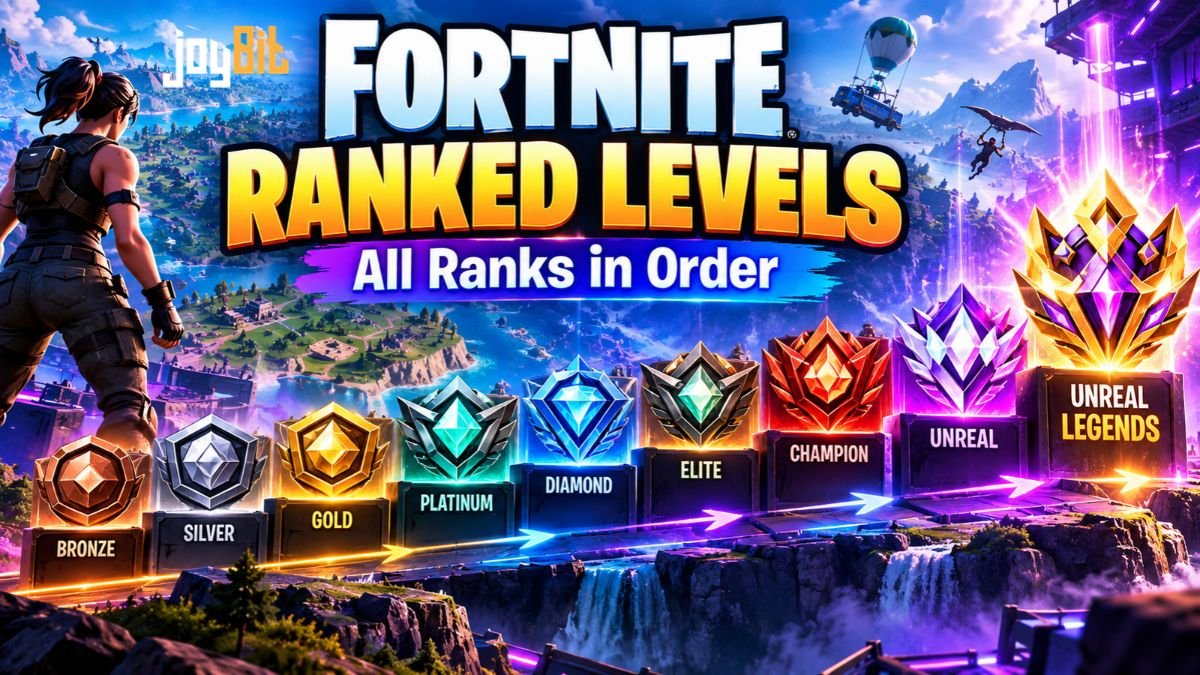
The current Fortnite ranked levels run from Bronze I through Champion III, followed by Unreal and the newer Unreal Legends rank. Epic Games’ Chapter 7 Season 4 competitive rules list 23 divisions in total: three each for Bronze, Silver, Gold, Platinum, Diamond, Elite and Champion, then Unreal and Unreal Legends. Unreal Legends is the highest level listed and has additional Skill Rating and leaderboard requirements.
Rank progression is not based on eliminations alone. Fortnite also considers placement, the strength of opponents, damage dealt and received, and how far a player survives through the Storm circles.
Fortnite ranked levels in order
As of October 2026, Epic’s Chapter 7 Season 4 Ranked Cups rules list the following progression from lowest to highest.
| Order | Rank |
|---|---|
| 1 | Bronze I |
| 2 | Bronze II |
| 3 | Bronze III |
| 4 | Silver I |
| 5 | Silver II |
| 6 | Silver III |
| 7 | Gold I |
| 8 | Gold II |
| 9 | Gold III |
| 10 | Platinum I |
| 11 | Platinum II |
| 12 | Platinum III |
| 13 | Diamond I |
| 14 | Diamond II |
| 15 | Diamond III |
| 16 | Elite I |
| 17 | Elite II |
| 18 | Elite III |
| 19 | Champion I |
| 20 | Champion II |
| 21 | Champion III |
| 22 | Unreal |
| 23 | Unreal Legends |
The Roman numerals mark divisions within a rank. For example, a player who progresses through Platinum moves from Platinum I to Platinum II and then Platinum III before advancing to Diamond I.
Elite and Champion now follow the same three-division structure as the lower ranks in Epic’s current competitive rules. Unreal is listed separately, followed by Unreal Legends.
What is Unreal Legends?
Unreal Legends sits at the top of the current ranked structure, but reaching Unreal is only the first part of qualifying for it.
Epic announced Unreal Legends in May 2026. To hold the rank, a player must meet all three conditions during a Ranked Season:
- Reach Unreal rank.
- Maintain a Skill Rating of at least 2,500.
- Be within the top 500 players on the Unreal leaderboard.
Unlike an ordinary promotion that simply remains once achieved, Unreal Legends depends on continuing to meet those requirements. Epic states that a player loses Unreal Legends status if any one of the three conditions is no longer satisfied.
The rank was subsequently included in Epic’s August 20, 2026 Chapter 7 Season 4 Ranked Cups rules, confirming its place in the current competitive rank list.
How Fortnite ranked levels work
Fortnite does not publish a simple formula such as “one elimination equals a fixed percentage of rank progress.” Instead, Epic’s current Ranked guide says several parts of a match contribute to progression or regression.
These include:
- Final placement in the match.
- Number of eliminations.
- Skill level of the opponents a player faces.
- Damage dealt compared with damage taken.
- The Storm circle reached before elimination.
The timing of a player’s performance also matters. Epic says late-game actions carry substantially more weight than early-game actions. A late elimination, for example, contributes more than an elimination secured when most of the lobby is still alive. Eliminating a stronger-ranked opponent can also be worth more than defeating a substantially lower-ranked player.
Placement is similarly more nuanced than simply finishing as high as possible. Fortnite considers how deep into the Storm-cycle progression a player survives. Epic’s guide explains that reaching a later Storm circle can sometimes produce greater progress than finishing slightly higher in a match that ends earlier for that player. Victory Royales provide the largest placement-related boost.
That means players trying to climb should not assume that chasing early eliminations is always the fastest way to progress. The published system gives meaningful weight to surviving deeper into matches and performing successfully against stronger opposition.
How Ranked matchmaking works
Ranked matchmaking is designed around player rank. Epic says Ranked lobbies are built using a player’s current rank, or the rank of the highest-ranked member when playing in a party.
The current Ranked guide covers Battle Royale, Zero Build, Reload and Reload Zero Build. Matchmaking is intended to put players against opponents at an appropriate competitive level rather than treating Ranked as a separate mode with completely random lobbies.
Epic also provides a daily First Match Loss Protection feature for each Ranked experience. The first Ranked match of the day will not cause regression when the player performs poorly. The protection does not mean the match automatically awards progress; it specifically protects against losing progress from that first match.
What happens when you reach Unreal?
Reaching Unreal changes how progression works at the top of the system.
Epic’s Ranked guide says that once a player reaches Unreal, they remain in Unreal until the next rank reset. Unreal players gain access to the Unreal leaderboard, where their standing can continue to change based on performance.
Unreal Legends adds another objective above that point. Because it requires both a Skill Rating threshold and a top-500 leaderboard position, simply reaching Unreal does not automatically make a player an Unreal Legend. A player must satisfy the three Unreal Legends requirements simultaneously.
This also explains an important distinction between Unreal and Unreal Legends: Epic describes Unreal as protected once reached for the season, while Unreal Legends can be lost if the player falls outside its Skill Rating or leaderboard requirements.
How rank resets and Skill Rating work
Visible ranks are periodically reset, but Epic changed how the underlying Skill Rating behaves in 2026.
In its May competitive update, Epic said that when ranks reset, players would retain their Skill Rating. That retained rating is then used to match players against others at a similar skill level.
In practical terms, a rank reset does not necessarily mean Fortnite treats an experienced high-level player as if they were completely new to Ranked matchmaking. The displayed rank can reset while Skill Rating continues to give the matchmaking system information about the player’s competitive level.
Epic also introduced more detailed post-match Ranked progress information so players can better see how eliminations and placements affect their rank.
Why some Fortnite rank lists are different
Players searching for Fortnite ranked levels may encounter conflicting lists, particularly around Elite, Champion and Unreal.
There is a genuine discrepancy within Epic’s own currently accessible documentation. The company’s general Ranked Play guide displays Elite I–III and Champion I–III, but its table also shows Unreal I, Unreal II and Unreal III.
By contrast, the dated Chapter 7 Season 4 Ranked Cups rules published on August 20, 2026 explicitly list Unreal as one division and Unreal Legends as the next and highest division. Epic’s May 2026 announcement also describes Unreal Legends as a new rank earned after reaching Unreal.
For that reason, the 23-level order in this article follows the more recent dated competitive rules and the separate official announcement introducing Unreal Legends rather than treating Unreal I–III as established current divisions.
How to start playing Ranked Fortnite
Epic’s current guide says Epic accounts that have never previously been used to log into Fortnite must first complete the Outlast 500 opponents quest before Ranked can be enabled.
After Ranked is available, players can choose a supported mode from Discover, open the mode-selection controls above the Play button and switch Ranked on before readying up.
Understanding the Fortnite ranked levels is therefore only part of the system. Progress depends on a combination of survival, eliminations, opponent strength and other match-performance factors, while the highest tier — Unreal Legends — also requires a specific Skill Rating and a place among the top 500 on the Unreal leaderboard.
Also read
Fortnite Tracker: The Ultimate Guide to Tracking Stats, Progress, and Performance