
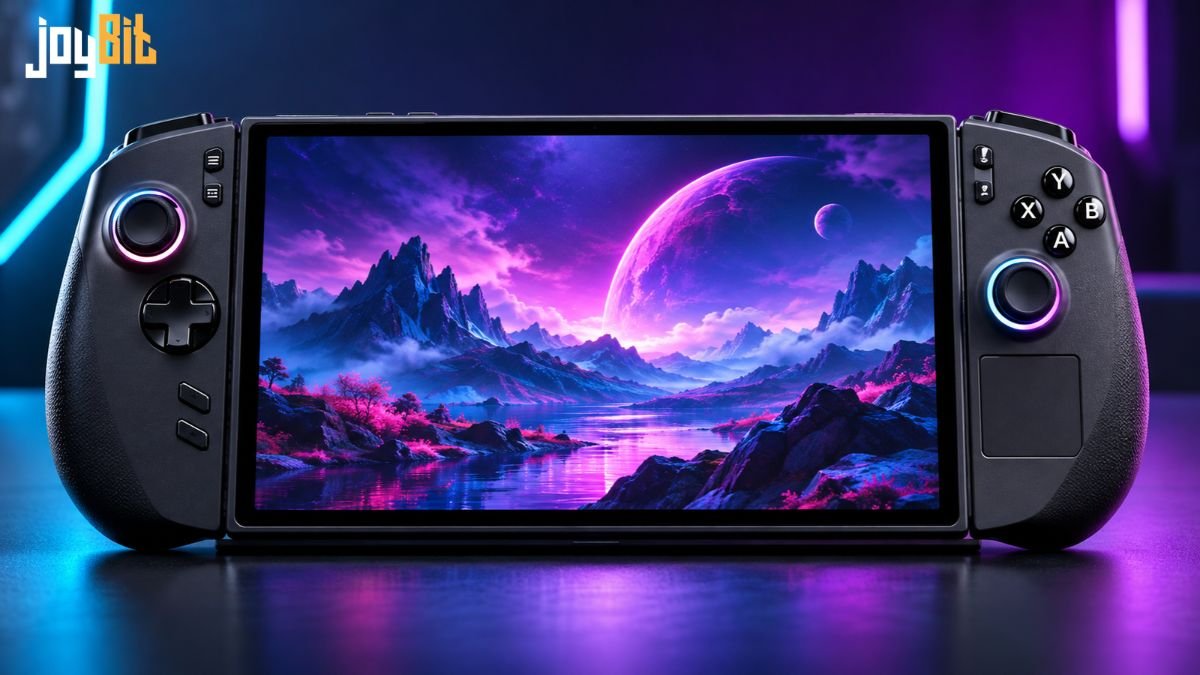
The Legion Go 2 is Lenovo’s second-generation 8.8-inch handheld gaming PC, introduced in September 2025. It combines a 144Hz OLED touchscreen, detachable controllers and a 74Wh battery with AMD Ryzen Z2-series processors.
The headline upgrades over the original are the screen, larger battery and redesigned controls. There are trade-offs: it weighs approximately 920g with its controllers, gaming endurance depends heavily on power settings, and prices have risen considerably in some markets.
For buyers in the UK and US, choosing the right processor and checking current prices are as important as the hardware itself.
Legion Go 2 Specifications at a Glance
Lenovo offers Windows configurations with AMD Ryzen Z2 or Z2 Extreme processors. The higher-end Extreme version uses integrated Radeon 890M graphics rather than a separate graphics card. Memory and storage vary by model and market.
| Feature | Confirmed specification |
|---|---|
| Display | 8.8-inch OLED touchscreen, 1920 × 1200 pixels, 144Hz, variable refresh rate |
| Processor | AMD Ryzen Z2 or Ryzen Z2 Extreme |
| Memory | 16GB or 32GB LPDDR5X |
| Storage | 512GB, 1TB or 2TB SSD options, depending on model |
| Battery | 74Wh rechargeable battery |
| Controllers | Detachable TrueStrike controllers with Hall-effect joysticks |
| Connectivity | Two USB4 ports, microSD, 3.5mm audio, Wi-Fi 6E, Bluetooth 5.3 |
| Weight | Approximately 920g (2.03lb) with controllers |
| Operating system | Windows 11 Home on Windows configurations |
These details are documented in Lenovo’s official Ryzen Z2 Extreme technical specifications, although exact memory, SSD capacity and included accessories depend on the model number.
The memory is soldered to the motherboard, so buyers should not assume they can upgrade it later. Storage is more flexible, with an internal M.2 SSD slot and a separate microSD card reader.
The OLED Display Is the Biggest Visible Upgrade
The first-generation Legion Go used an 8.8-inch IPS screen with a higher 2560 × 1600 resolution. The second generation reduces that to 1920 × 1200 but changes to OLED technology.
OLED pixels produce their own light and can switch off individually, delivering deep blacks and strong contrast. Lenovo’s new display also supports HDR and a variable refresh rate ranging from 30Hz to 144Hz.
Variable refresh rate, or VRR, allows the screen to adapt to changing game frame rates. This helps reduce visible tearing and judder when performance fluctuates.
However, a 144Hz display does not mean every demanding PC game will run at 144 frames per second. The actual results depend on the processor, graphics settings and game.
The glossy OLED screen is also worth considering for players who regularly use their handheld near bright windows or under strong overhead lighting.
Detachable Controllers and a Flexible Design
Lenovo has retained the original design’s most distinctive feature: controllers that slide off either side of the screen.
A built-in kickstand allows the display to stand on a table while the controllers are detached. The right controller can also fit into a dedicated base and function as a vertical, mouse-like input in FPS mode, intended for first-person games.
The redesigned TrueStrike controllers include Hall-effect joysticks, which use magnetic sensing rather than conventional contact-based positioning. They also feature configurable controls, a D-pad and a touchpad on the right.
That touchpad is particularly useful on Windows because some desktop menus still require pointer-style interaction.
There are two USB4 connections, positioned at the top and bottom, for charging, compatible external displays and docking equipment. A fingerprint reader is incorporated into the power button.
The disadvantage is size. At approximately 920g, the device is heavier than many smaller handheld gaming PCs. Using the kickstand or removing the controllers can reduce the weight a player needs to hold.
Gaming Performance: What Can You Expect?
The Ryzen Z2 Extreme version combines an eight-core processor with Radeon 890M integrated graphics.
It is capable of running demanding PC games, but results depend on the title, resolution, graphics preset and selected power mode. Less demanding games can make better use of the high-refresh-rate display, while graphically intensive releases often require adjustments.
In Tom’s Hardware testing of a Z2 Extreme configuration, Tony Hawk’s Pro Skater ran at approximately 73–93 frames per second using 1280 × 800 resolution and high settings in Performance mode.
Marvel’s Midnight Suns reached a 60fps cap at medium settings in Balanced mode.
These are recorded results from specific tests, not guaranteed performance figures for every device or software version.
Although the native 1200p display provides useful clarity, rendering demanding games at 800p can reduce the graphics workload. Lowering resolution or adjusting visual settings is therefore a practical way to improve frame rates.
Battery Life: How Long Does It Last?
The 74Wh battery is substantially larger than the original model’s 49.2Wh unit.
Lenovo also specifies rapid charging, claiming the battery can reach up to 50% charge in approximately 30 minutes under suitable conditions.
However, a larger battery does not automatically translate into all-day gaming.
In Notebookcheck’s independent battery testing, the following approximate runtimes were recorded:
- Performance mode: Two and a half hours.
- Balanced mode: Just under three hours.
- Silent mode: A little over five hours.
- Maximum-power Manual mode: One hour and 17 minutes.
These figures apply to the tested configuration and settings rather than every possible gaming workload.
Players using higher-performance modes should plan for relatively short unplugged sessions. Lighter games and reduced power settings can extend battery life, while brightness, wireless activity and battery age also affect endurance.
Legion Go 2 Price and Availability in the UK and US
Pricing deserves particular attention because original launch figures no longer reflect every current retail listing.
As of 22 November 2026, UK retailer Currys listed a Ryzen Z2 configuration with 32GB RAM and 512GB storage at £1,049.
Its higher-end Ryzen Z2 Extreme model, equipped with 32GB RAM and a 1TB SSD, was listed at £1,199.
In the United States, Best Buy listed the Ryzen Z2 Extreme model with 32GB RAM and 1TB storage at $1,999.99. That was considerably higher than the $1,349.99 price reported for the same broad configuration around its original launch period.
These are retailer listings, not permanent recommended retail prices. Promotions, stock availability and configurations may change.
Buyers should compare the processor, RAM and storage rather than product names alone. A cheaper model may feature a different Ryzen chip or smaller SSD, while prices in the UK and US reflect different markets.
Windows 11, SteamOS and Game Compatibility
Windows 11 gives the established models access to familiar Windows PC game launchers, including Steam and the Xbox PC app, subject to individual game requirements.
Lenovo’s Legion Space software provides access to device settings, controller customisation and performance controls.
However, standard Windows desktop navigation is not always convenient with handheld controls, even with a touchscreen and touchpad.
Lenovo also announced a separate SteamOS-equipped model in January 2026.
The company’s official announcement of the SteamOS version stated an estimated US starting price of $1,199 and targeted availability from June 2026.
Those were announcement-stage estimates, not confirmation that the model reached retailers at that price or date. Buyers seeking SteamOS preinstalled should check the operating system and availability of the exact configuration.
SteamOS provides an interface designed around gamepad controls and Steam gaming. Windows offers broader access to conventional PC software and launchers.
Game compatibility still depends on the individual title and operating system. Having a game in a Steam library does not automatically guarantee that every feature will function on SteamOS.
Is It Worth Buying?
The strongest reasons to consider this handheld are its large OLED display, detachable controllers, integrated kickstand and flexibility as a Windows gaming PC.
Its limitations are equally important: substantial weight, relatively short battery runtimes under heavy workloads, and the high cost of some configurations.
For players who regularly use a tabletop stand, connect an external monitor or value the detachable controller options, the design provides features that conventional fixed-controller handhelds cannot match directly.
Buyers prioritising a lighter travel device, longer unplugged gaming sessions or a lower purchase price face a different set of trade-offs.
The Legion Go 2 offers a distinctive combination of PC gaming hardware and flexible controls, but the exact processor, memory, storage, operating system and regional price should determine the buying decision.
Also read
Nitro Deck: The Handheld Gaming Upgrade That Changed How Players Experience Nintendo Switch
Xbox Game Pass Ultimate: Why Gamers Can’t Stop Talking About It