

You find yourself rummaging through old drawers and cabinets in your ancestral home as you help your parents clean the place. You then stumble upon an old, wooden box covered in dust that seems to have been undisturbed for quite some time.
You gently wipe the dust with a rug that you’ve been using earlier, and carefully unlock the wooden box’s latch. As you slowly open it, you can already tell what was waiting inside without completely unhinging the lid. The first thing you notice is the rustic, time-worn leather and metal straps. They’re old watches neatly arranged upon the smooth inner cushion and linen lining of the wooden box.
You pick one up to scrutinize the vintage timepiece. It seems these were either your father’s or your grandfather’s collection, which was almost forgotten. You carefully place it on your wrist, gently adjusting the weathered strap to try it on.
With a few flicks and shakes of your wrist while you’re checking to see how it looks on you at different angles, you suddenly feel a weak vibration emanating from the center of the casing as it’s pressed upon your wrist. A movement. Suddenly, you hear a faint ticking. It’s alive. One of the hands on the dial is moving again after a long slumber.
You’ve unknowingly brought this piece of history back to life through the kinetic energy produced in your earlier movements while you were trying it on.
This is the magic of mechanical watches.
Mechanical watch lifespan
To understand how this happened, you need to know how mechanical watches work. As the very term implies, this type of watch does not use any electronic parts or any mechanisms powered by batteries.
Mechanical watches rely on many different gears, pinions, springs, jewels, and rotor-like fittings to operate. This weighted rotor spins freely as you move your arms while wearing the watch, which in turn, winds the mainspring, which then stores the kinetic energy produced by your movement, powering the watch and operating the rest of the components.
In theory, the physics and engineering behind mechanical watches allow them to function perpetually, as long as you are wearing them. They will stay “alive” as long as you’re providing them with enough kinetic energy. And because of that, the mechanical watch’s lifespan could technically outlive a lifetime.
If the concept of mechanical watches and the “magic” behind automatic watch longevity fascinates you after learning how all of those work, it’s time to check these amazing examples from Alba.
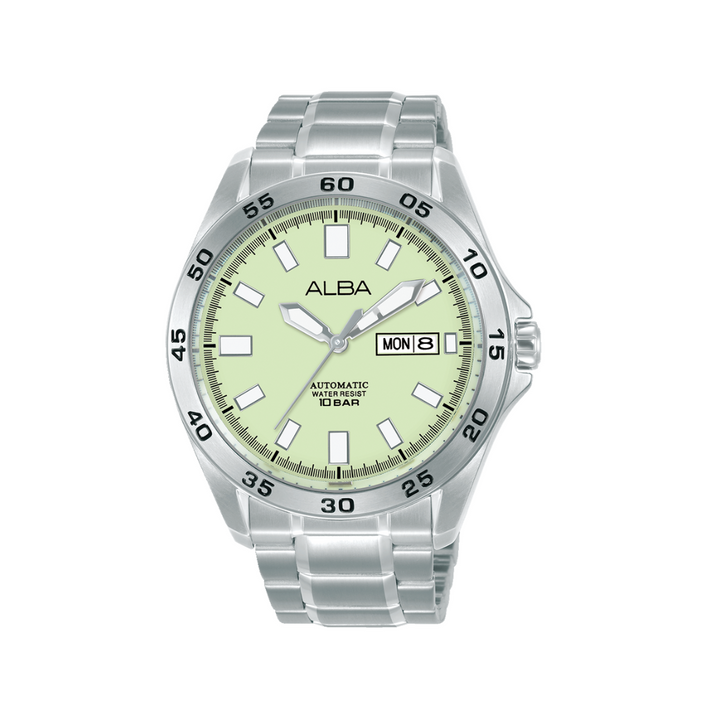
AL4755X1 Mechanical Full Luminous: A beacon through generations
The “passing of the torch” to light the next generation’s beacon is an idea perfectly exemplified by this unique timepiece. Unlike other mechanical watches, the AL4755X1 features a day & date window and a full luminous LumiBrite dial, presenting a crisp, lime green hue during daytime. As nighttime looms, the dial, watch hands, and indices will glow in vivid green with impressive clarity, ensuring excellent readability even in low-light conditions.
The AL4755X1 is powered by the Calibre Y676 Mechanical Movement, which can be seen via the see-through screw-down case back, showcasing the intricate movement within.
Built to last and survive even harsh outdoor environments, the 43mm diameter and 13.02mm thick casing is made of stainless steel, and the same goes for its steel wrap bracelet. With the mineral crystal glass and 10 Bar water resistance rating, this timepiece capably demonstrates the durability of mechanical watches.
AL4211X1 Mechanical Blue: To the deep end
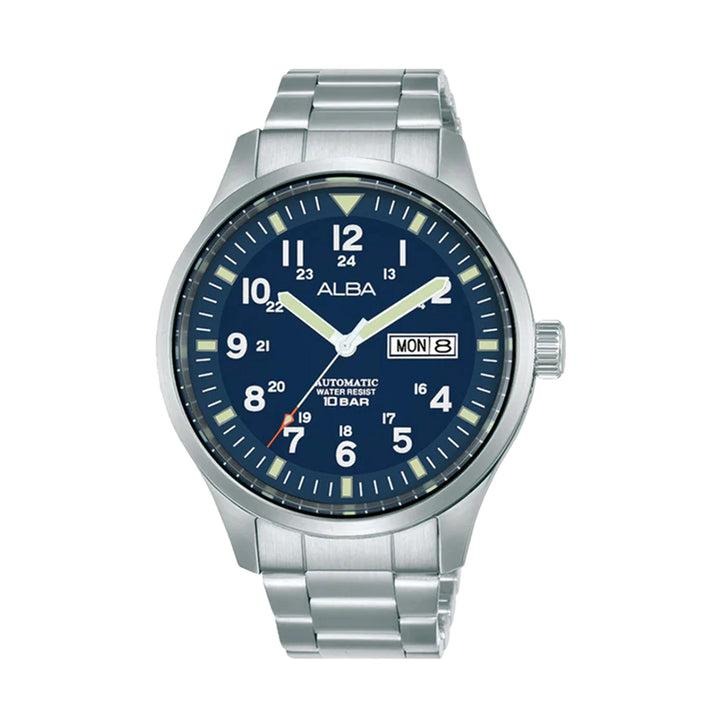
Mechanical watches meant to endure decades should be accompanied by a timeless design that never goes out of style. The deep blue dial is accentuated with a day & date window, LumiBrite indices, and LumiBrite watch hands. Just like the previously mentioned AL4755X1, these LumiBrite indices and hands will glow vibrantly as soon as darkness looms.
Powered by the Calibre Y676 Automatic Mechanical Movement, which is housed in a 42mm diameter and 12.5mm thick stainless steel casing with a mineral crystal glass, this timepiece can outlast generations of mechanical watches.
With a 10 Bar water resistance rating and durable stainless steel wrap bracelet, this timepiece will withstand even the most vicious of storms and floods.
It’s a legacy that you can pass down to the next generations, inheriting the stories from bygone years as well as those that come with this timepiece.
AU4075X1 Mechanical Yellow: A bold challenge to time
Automatic watch longevity doesn’t always mean that its design has to be ‘quiet’ or simple. There are still those who choose to live life ‘loudly’ and full of sparks.
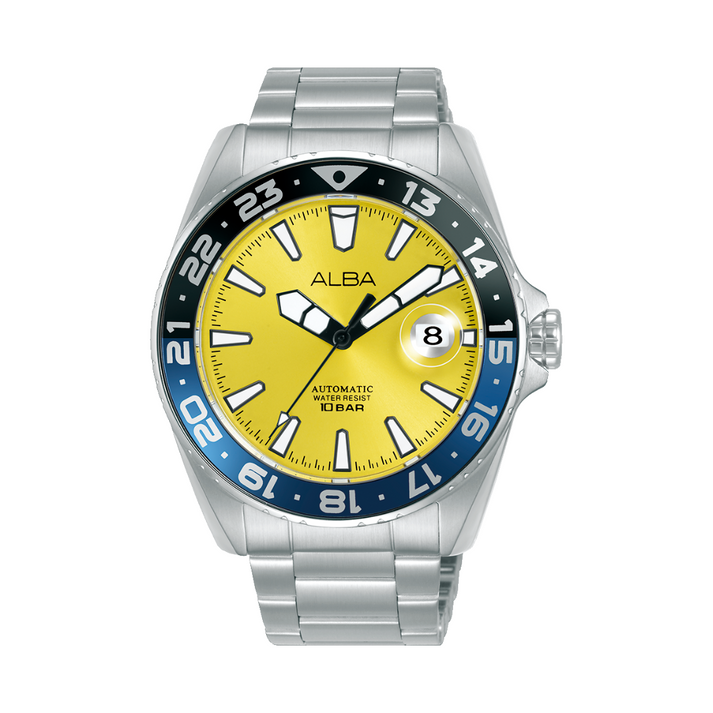
Meet the AU4075X1, this timepiece is more than just a bold statement – It’s a challenge to time’s passing. The vibrant, high-contrast yellow dial and the blue two-way rotating bezel, complemented by the bold, white indices and watch hands, deliver an immediate impact and presence.
Inside the Mineral crystal glass, stainless steel wrap bracelet, and the 43mm diameter divers-style stainless steel casing lies the Calibre Y675 Automatic Mechanical Movement. Even though the entire design leans towards the bulkier, sporty aesthetics, the 13.72mm thick casing still sits snugly on the wrist.
The 10 Bar water resistance rating guarantees that it will survive all the violent downpours and splashes thrown at it as you blaze and cut through the storm while wearing this timepiece.
Alba Mechanical Watches – An inherited legacy
Just as the master Japanese craftsmen passed on their techniques and watchmaking knowledge to their apprentices, the mechanical watches you’d buy today can someday become heirlooms accompanied by interesting stories and experiences that you can bequeath to the next generation.
Mechanical watches can indeed outlive lifetimes if they are properly maintained and handled.