

The moment you first draw a slope, press play, and watch a sled glide along your lines, you realize: Line Rider is more than a game. It’s a canvas, an experiment, a playful marriage of physics and aesthetic freedom. In its simplicity lies deep creative potential. In this article, we’ll explore how Line Rider evolved, why it became a creative medium, and how its community continues to push the boundaries of art, music, and imagination.
The Spark: Origins and Early Growth
Line Rider was created in 2006 by a Slovenian student, Boštjan Čadež. What began as a simple illustration class project quickly grew into a viral sensation. Čadež combined his interests in drawing, animation, and physics to design a digital “toy” where players draw lines, press play, and watch gravity take over.
He uploaded his project online, and within days it captured the imagination of millions. Blogs, online forums, and early social platforms were buzzing with clips of players experimenting with their own tracks. What made Line Rider different was its lack of traditional goals. There was no scoring system, no missions to complete. Instead, players were given a blank canvas where creativity and imagination set the rules.
As its popularity soared, the game expanded to platforms like Windows, Nintendo DS, and Wii. Community versions and fan projects later emerged, adding more tools and extending its possibilities.
Simplicity as a Foundation
At first glance, Line Rider looks almost too simple: draw lines, hit play, and the sledder—often nicknamed “Bosh”—rides along. Yet, this simplicity is its secret strength.
The physics engine ensures that every line matters. A smooth curve allows for graceful gliding, while sharp edges or steep drops can send the sledder flying off course. The unpredictability of how physics interacts with the lines keeps every track unique and exciting.
This delicate balance of control and chaos fuels creativity. Players can attempt loops, jumps, and gravity-defying stunts, but success demands patience and precision. Even though new features have been added over the years—like zoom tools, erasers, and special track lines—the essence remains the same: draw, watch, and imagine.
Tracks as Visual Art
Over time, players realized that Line Rider could be much more than just a playground for stunts. Tracks became elaborate art pieces. Some creators drew vast landscapes, turning their lines into mountains, forests, or cities. Others told stories through carefully designed motion sequences.
These tracks often resemble living sketches. A sledder might carve through a snowy valley, tumble down a canyon, or fly across a starlit sky. Each line isn’t just a path—it’s a brushstroke that sets the stage for a moving picture.
For many, Line Rider became a form of animation. Creators learned to choreograph every moment, making their tracks flow like short films. The results show how a minimalist digital tool can be transformed into a rich artistic medium.
Music Synchronization: Motion Meets Melody
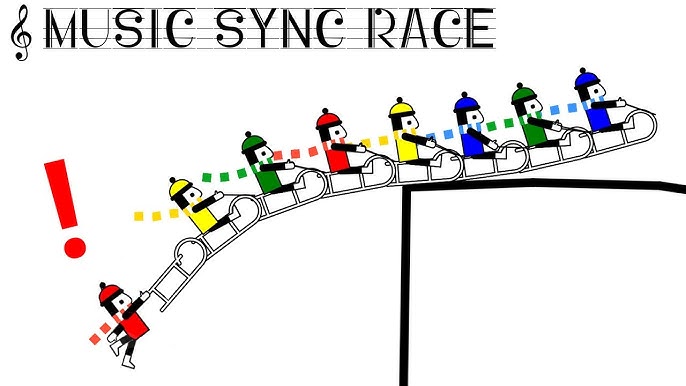
One of the most remarkable evolutions in Line Rider’s history is its combination with music. Players began designing tracks that synchronized perfectly with songs. Every drop, jump, and loop was timed to match beats, melodies, or dramatic crescendos.
Classical pieces, pop songs, and electronic tracks all found new life in these music-driven creations. Watching the sledder soar in rhythm with Beethoven or speed through loops in sync with modern beats turned Line Rider into a form of kinetic music video.
The challenge lies in precision. Creators must carefully map every moment so that the physics of the track matches the tempo of the music. When executed flawlessly, the results are breathtaking—motion and sound blending into a seamless piece of art.
Community and Shared Creativity
The enduring success of Line Rider is deeply tied to its passionate community. From the early days of forums to the rise of YouTube, players have been sharing, collaborating, and inspiring each other.
Communities organized competitions, challenges, and collaborative projects. Some focused on technical mastery—who could create the smoothest loop or the longest ride—while others leaned into storytelling or music synchronization.
Fan-made versions also expanded the creative toolkit. New colors, track types, and extended canvases gave players even more freedom to bring their visions to life. This constant cycle of sharing and innovation kept Line Rider fresh long after its initial release.
The game has also been celebrated in exhibitions, articles, and retrospectives, acknowledging its impact not only as entertainment but as digital art. Its influence can be compared to other creative platforms like Minecraft or LittleBigPlanet, where user imagination drives the experience.
Why Line Rider Still Captivates
More than fifteen years later, Line Rider continues to inspire. But why does such a simple tool still hold so much appeal?
Nostalgia and charm. Many people return to relive the joy of their early internet days, rediscovering the same wonder they felt the first time they pressed play.
A creative outlet. For artists and casual players alike, Line Rider is an open canvas. There are no limits—only what the creator envisions.
Educational potential. Teachers and science enthusiasts have used Line Rider to demonstrate physics concepts like acceleration, gravity, and motion.
Community culture. The game thrives on collaboration and creativity. Each new masterpiece inspires others, keeping the cycle alive.
Timeless simplicity. In an age of complex graphics and fast-paced gaming, Line Rider’s stripped-down design feels refreshing. It’s proof that sometimes the simplest ideas last the longest.
What Line Rider Teaches Us
Beyond its entertainment value, Line Rider carries lessons about creativity and play. It shows how limitations can spark innovation. By stripping away objectives and keeping the design minimal, the game gave players freedom to explore possibilities on their own terms.
It also demonstrates that art and play don’t have to be separate. A simple sledding toy evolved into a powerful medium for animation, storytelling, and musical expression.
Most importantly, it highlights the role of community in shaping culture. While its creator provided the foundation, it was the dedication of fans around the world that turned Line Rider into a legend.
Conclusion
Line Rider is not just a nostalgic internet game—it’s a cultural artifact that proves creativity thrives in unexpected places. From classroom projects to viral videos, from artistic animations to synchronized music tracks, it has transcended its humble origins to become a unique blend of art, music, and imagination.
Even today, drawing a single line and pressing play feels magical. The sled begins its journey, and for a moment, you’re reminded that creativity doesn’t always need complex tools. Sometimes, all it takes is a line, a rider, and imagination.