

The transition from high school mathematics to university-level accounting is often described as a “culture shock.” For undergraduate students across the globe, the challenge isn’t just about crunching numbers; it’s about interpreting the story those numbers tell about a business’s health. As the semester nears its end, the pressure of financial finals begins to loom. These exams are not merely hurdles to clear; they are the gateway to professional credibility in a field that demands absolute precision and ethical integrity.
Navigating complex topics like consolidated financial statements, deferred tax liabilities, or forensic auditing requires more than just rote memorization. Many students find that the jump in difficulty between introductory and intermediate courses is where they need the most support. During these peak periods, seeking specialized accounting assignment help can provide the clarity needed to grasp intricate concepts that textbooks sometimes overcomplicate. By breaking down case studies into manageable parts, students can build a foundation of knowledge that serves them well beyond the classroom, turning academic stress into a structured learning opportunity.
The Evolution of the Modern Accounting Curriculum
Accounting is no longer just “the language of business”—it is the data hub of the modern corporate world. Today’s undergraduates are expected to be proficient in International Financial Reporting Standards (IFRS) while also understanding the nuances of local GAAP. This globalized curriculum ensures that a student in London, Sydney, or New York is prepared for a borderless career.
However, this breadth of study adds layers of complexity. You are expected to be a technician, a strategist, and an ethicist all at once. The “Financial Finals” often test your ability to apply these standards to real-world scenarios, such as merger acquisitions or international trade disputes, where there is rarely a single “correct” answer, but rather a most “justifiable” one.
Strategies for Effective Revision
Success in accounting finals is rarely the result of a “cram session.” Because the subject is cumulative, if you don’t understand the basic “Debit and Credit” logic of the first week, the “Cash Flow Statements” of week ten will be impossible.
- Active Recall: Don’t just read your notes. Close the book and try to reconstruct a Trial Balance from memory.
- The T-Account Method: When in doubt, draw it out. Visualizing the flow of transactions helps prevent errors in double-entry bookkeeping.
- Time Management: Practice past papers under timed conditions. In an accounting exam, the biggest enemy is often the clock, not the questions.
Bridging the Gap: Academic Support and Mental Health
The psychological toll of high-stakes testing is a significant factor in student performance. It is common to feel overwhelmed when a single 3-hour exam accounts for 60% of your final grade. This is where strategic resource management becomes essential. Students who excel often utilize various tools to supplement their learning.
For instance, when the sheer volume of technical material becomes unmanageable, many choose to consult experts at Myassignmenthelp to refine their exam techniques. Utilizing services to take my accounting exam for me with expert guidance allows students to identify their weak spots and approach their finals with a strategy tailored to their specific curriculum. This proactive approach helps in reducing “exam fog” and ensures that the technical details of cost accounting or auditing don’t get lost in the heat of the moment.
Key Financial Concepts to Master
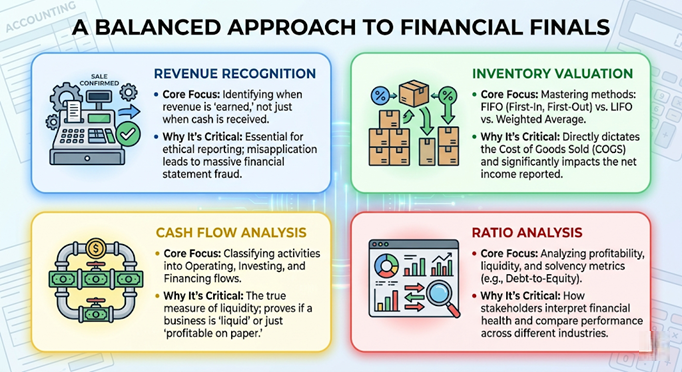
To help you focus your revision, here is a breakdown of the core areas that most frequently appear in undergraduate financial finals:
| Concept Area | Core Focus | Why It’s Critical |
| Revenue Recognition | Identifying when a sale is “earned” | Critical for preventing financial statement fraud. |
| Inventory Valuation | FIFO vs. LIFO vs. Weighted Average | Directly impacts the Cost of Goods Sold and net income. |
| Cash Flow Analysis | Operating, Investing, and Financing activities | Determines if a business is actually “liquid” or just “profitable on paper.” |
| Ratio Analysis | Liquidity, Solvency, and Profitability ratios | Allows stakeholders to compare performance across different industries. |
The Role of Technology in Accounting Finals
We are currently witnessing a shift where paper-and-pen exams are being replaced by spreadsheet-based assessments. As an undergraduate, your ability to use Excel is now as important as your understanding of the ledger. Modern exams may require you to build dynamic models where changing one variable updates the entire financial statement.
This technical requirement adds another layer of difficulty. Not only must you know the accounting rule, but you must also know how to program it. Preparing for this requires consistent practice with digital tools and an understanding of how data flows through an Enterprise Resource Planning (ERP) system.
Information Gain: Why Ethics Matter More Than Ever
One area where Google rankings and academic integrity overlap is the concept of “Information Gain.” In your essays and exam answers, examiners aren’t looking for a Wikipedia summary. They want to see your unique perspective on contemporary issues, such as Environmental, Social, and Governance (ESG) reporting.
How does a company account for its carbon footprint? How do we value intangible assets like brand reputation in a digital economy? Addressing these questions in your finals demonstrates that you aren’t just a calculator—you are a thinker.
Final Countdown: The 48-Hour Plan
- 48 Hours Out: Review all major formulas and standards. Ensure your calculator is approved for the exam hall.
- 24 Hours Out: Focus on “Easy Wins”—definitions, ratios, and basic entries. Do not start learning new, complex topics now.
- 12 Hours Out: Rest. Studies show that sleep deprivation leads to “transposition errors” (flipping numbers), which are fatal in accounting.
- Exam Morning: Eat a protein-rich breakfast. Avoid talking to panicked classmates outside the hall; stay in your own “accounting bubble.”
Conclusion
The journey through a business or accounting degree is a marathon, not a sprint. While financial finals are daunting, they are designed to prepare you for the high-pressure environment of the corporate world. By utilizing the right resources, staying disciplined with your revision, and maintaining a healthy perspective on your goals, you can navigate these challenges successfully. Remember, every professional accountant sat exactly where you are now. The difference between those who succeed and those who struggle is often just a matter of preparation and the willingness to seek help when the numbers stop making sense.
Frequently Asked Questions (FAQ)
Q: Can I use a financial calculator in all exams?
Ans: This varies by university. Most allow basic scientific calculators, but some advanced finance modules require specific models like the TI BA II Plus. Always check your syllabus.
Q: What is the most common mistake in accounting finals?
Ans: Forgetting that the Balance Sheet must, by definition, balance. If it doesn’t, students often panic. The best tip is to leave a “suspense account” note and move on to the next question to save time.
Q: How do I stay updated on changing accounting standards?
Ans: Follow the official IFRS and FASB websites. Many professional bodies also offer student newsletters that summarize major changes in an easy-to-read format.
Q: Is it better to focus on theory or practice questions?
Ans: In accounting, practice is king. You can understand the theory perfectly, but if you haven’t physically balanced a ledger, you will likely make mechanical errors during the exam.